cloud

Nov 05 20:32

A long overdue report of DevopsDays

Here's how it started :

So I used to be a software developer, writing perl for the web, then C, then Java, then PHP, till I realized nobody ever configured my servers correctly and I changed trades becoming a system engineer, while teaching new developers the basics of their trade, whom grew into doing Infrastructure Architecture .. familiar story for much of the crowd at DevopsDays ... a crowd that wants to stopping the war between developers and system engineering , a crowd that wants to automate builds, integrate testing, deploy, deploy on very large scale, deploy in the cloud and much more.

So what do you get when you put together some of the experts on building software, organizing development teams , Agile geeks, Cloud infrastructure projects, and Automating guru's in 1 location for 2 days in Gent ? Exactly .. DevopsDays ..

The format was 2 days .. 3 kickass formal talks in the morning.. Open Space sessions in the afternoon. ... Friday featured talks on Non Functional Requirements, CucumberNagios and Monitoring in the Cloud with FlapJack and Building Agile Infrastructures with Puppet while discussing the James White Manifesto ..

which I had never heard of, but which apparently comes down to this

  1. == Rules ==
  2. On Infrastructure
  3. -----------------
  4. There is one system, not a collection of systems.
  5. The desired state of the system should be a known quantity.
  6. The "known quantity" must be machine parseable.
  7. The actual state of the system must self-correct to the desired state.
  8. The only authoritative source for the actual state of the system is the system.
  9. The entire system must be deployable using source media and text files.
  10.  
  11. On Buying Software
  12. -------------------
  13. Keep the components in the infrastructure simple so it will be better understood.
  14. All products must authenticate and authorize from external, configurable sources.
  15. Use small tools that interoperate well, not one "do everything poorly" product.
  16. Do not implement any product that no one in your organization has administered.
  17. "Administered" does not mean saw it in a rigged demo, online or otherwise.
  18. If you must deploy the product, hire someone who has implemented it before to do so.
  19.  
  20. On Automation
  21. -------------
  22. Do not author any code you would not buy.
  23. Do not implement any product that does not provide an API.
  24. The provided API must have all functionality that the application provides.
  25. The provided API must be tailored to more than one language and platform.
  26. Source code counts as an API, and may be restricted to one language or platform.
  27. The API must include functional examples and not requre someone to be an expert on the product to use.
  28. Do not use any product with configurations that are not machine parseable and machine writeable.
  29. All data stored in the product must be machine readable and writeable by applications other than the product itself.
  30. Writing hacks around the deficiencies in a product should be less work than writing the product's functionality.
  31.  
  32. In general
  33. ----------
  34. Keep the disparity in your architecture to an absolute minimum.
  35. Use [http://en.wikipedia.org/wiki/Set_theory Set Theory] to accomplish this.
  36. Do not improve manual processes if you can automate them instead.
  37. Do not buy software that requires bare-metal.
  38. Manual data transfers and datastores maintained manually are to be avoided.

Much unlike the FAIL Manifesto

The openspaces tackled how to migrate from a totally unreproducable environment too a correctly bootstrapped infreaastructure, over the Ubuntu Enterprise Cloud , then dinner and off for beers to the Vooruit . The OpenQRM "crowd" stayed at my place so I didn't stay around too late ..

Saturday morning came early ... sadly I missed the first 10 minutes of a very interresting talk about Kanban in operations ... let's ee if we can convince some more people to try it out ...

The talk on Continuous integration, Build Pipelines and Continuous deployment was also really interresting with lots of stories from the real world.. . after the openqRM talk it was time again for OpenSpaces with e.g discussions on svn vs git and building a feature matrix of Cloud , with @botchagalupe, @openqrm and @maesjoch in the room and @diegomarino online .

Devopsdays ended too soon , with way to much interresting ideas to build on .. Let's hope we can all work them out !

Apr 10 20:21

CloudCamp Antwerp

So yesterday a 100+ crowd met in the Antwerp Zoo.
I heard different comments from that crowd... some of them liked the event, good networking, interresting topics , a broad overview, meeting new vendors active in the Cloud, others of them didn't .. it wasn't a real camp , just some vendors pitching, they didn't hear any new stuff , or we didn't touch the real stuff.

So different opinions from different expectations...

Anyhow for all those who could't read the slides :

Or here

Mar 16 2009

VirtSec, and Open Source

The slides from the presentation I gave last friday at Lsec are now online, both at My Site and on Slideshare

I learned a lot last friday , I`ll be talking to some more people about the technical details , but be expecting some of my findings on Virtualization.com soon :)

Feb 05 2009

Image Sprawl , and the new cure ..

When I tell people that the concept of copying VM's around as frequently done in the VMWare world is one of the most stupid ideas on this planet, I get the weirdest looks.

In my world it is, I want my infrastructure to be reproducible , I want to be able to throw any machine in my infrastructure out of the 10th floor of a building and be up and running again in no time. If I spread a bunch of VM copies around who knows what kind of life they start leading. Some will get upgrades, some won't ..
If I get an image from someone, how did he get there ? Nobody knows ..

To me Image Sprawl is more than not being able to to manage your Virtual Machines, it also matters for physical machines that are being deployed using a golden image.

Now rewind back about 4 something years.. back then I wrote a paper for LinuxKongress titled Automating Xen Virtual Machine Deployment which described a Hybrid way of Bootstrapping an infrastructure.
Quicly summarized, you use the benefits of images to quickly deploy a minimal image which
Luke today calls a Stem Cell then go on using centralized package management and a configuration management tool to keep them up to par. There are 2 things that changed in between,
we replaced CFEngine with Puppet , and the fact that today some people do care a bit more about the infrastructure side of the web, guess we have to thank Amazon and the Cloud Hype for that

But fundamentally .. not that much changed :)

Jan 21 2009

Oldskool, Fuck the Cloud

This comment by Jim Leonard, Trixter/Hornet for those who still remember our previous lives , is right on the spot.

"This is the longest post I’ve ever seen that says “do not put your only copy of data on a site you do not pay for or trust.”

Weird, how you suddenly bump online into someone you haven't heard from for over a decade, and even weirder how they still seem to have similar ideas to yours :-)

Dec 19 2008

JoliCloud

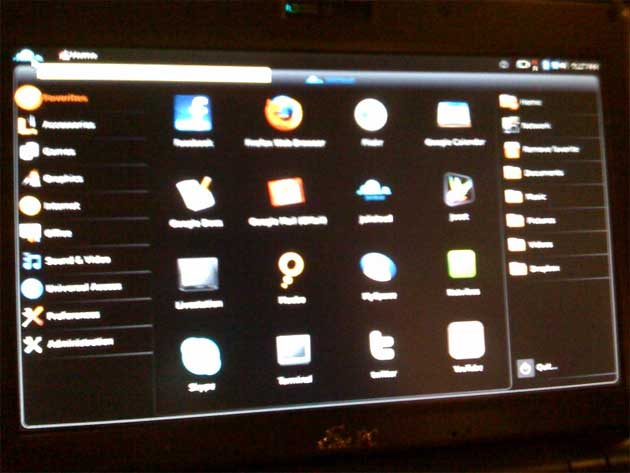
Am I the only one who thinks the JoliCloud screenshot on TechCrunch really really looks like a default eeebuntu setup ?

Technorati Tags:Technorati Tags:
Oct 31 2008

This was not a Cloudcamp ! :)

This was not a CloudCamp !

Don't get me wrong, it was a great event and I met lots of interesting people , but it was not a *camp.
The idea was there to have an unconference after the formal sessions, but the formal sessions ran out and there was no time because of food and bar duties.

The event was a mixture of regular Belgian Campers, Virtualization geeks, Open Source folks , obviously there were a couple of "lost" americans , and the crowd from up North :)

The location was weird to say the least, what if the boat hat floated off on the river :)

It's obvious the world doesn't have a fixed definition for "Cloud Computing" yet , Tarry really made a safe bet by cut and pasting the definition from WikiPedia but the thing that really worried me was that when Raph asked if the audience could define Open Source they couldn't either.

Given the audience it's really hard to understand why they couldn't explain what Open Source is .. they should be able to. As the biggest chunk of Cloud Infrastructure is based on Open Source , the audience of a CloudCamp should be able to define Open Source, but then again there was quite a number of suits around that weren't expected to understand what it is all about :)

The fact is that a the cloud today still is a bit of undefined, different marketeers are grabbing the opportunity to rebrand their longtime existing product as fresh and hot cloud.

The interesting part of the Cloud to me is the mix of Virtualization, Scalability, Automation , Large Scale Deployment , playing the puppetmaster, and High Availability ..

It's stuff I have been doing for ages , it's the stuff this blog has been covering since the beginning ... but I don't plan on renaming my blog .. as afterall the whole cloud issue is just a Freaking DNS Problem

Pictures of the event are here

Oct 27 2008

DevMinistration

In his CloudCafe 18 Podcast John talks about Puppet to Luke and they coin the idea of Devministration

I really like the terminology, so I`m a devministrator, and probably the bigger part of Inuits are Devministrators.

The first stage in becoming a devministrator is using version control, then bugtracking .. etc.
Coming from an era where I was the sysadmin pushing the developers to use version control this sounds really strange to me..
Yes I had to convince developers to use version control, while Luke thinks he needs to convince sysadmins to use version control.
Weird.. other continent, other habits, but the important part is we all use it.

But the big part is that we don't spend our time managing servers, but rather scripting the automation of the management. Learning machines how they should manage our configs and automate.

Like the old Google saying, you have to automate yourself out of a job every 18 months.

Guess that's also what ad Devministrator is.

Oct 27 2008

CloudCamp BXL

Don't forget .. this thursday : CloudCamp Brussels !

Technorati Tags:Technorati Tags:
Sep 25 2008

Is the internet ready ?

Tarry pointed us to an article questioning if the internet is ready for cloud computing.

The short summary,
the biggest challenge is DNS.

Is DNS going to be secure enough, scalable enough etc.

Don't say I didn't warn you .. "Everything is a Freaking DNS Problem !"